Crawl Space Insulation in Northern Virginia — Spray Foam, Vapor Barriers & Encapsulation
Northern Virginia's humid continental climate makes proper crawl space treatment one of the highest-ROI improvements a homeowner can make. 16+ years serving Falls Church, Fairfax, Reston, Herndon, and all of NoVA.
Free Crawl Space Inspection
Schedule Inspection
Why Northern Virginia Crawl Spaces Need Special Attention
Falls Church and the surrounding NoVA region sit in ASHRAE Climate Zone 4A — characterized by humid summers (outdoor relative humidity averages 72–75% in July and August) and cold winters where ground temperatures drop to 28–35°F. An uninsulated crawl space in this climate becomes a humidity pump: summer soil moisture evaporates upward, raising crawl space RH to 80–95%, while winter air drops floor temperatures and creates condensation cycles on cold surfaces.
The practical consequence: roughly 50% of the air in your first-floor living spaces comes from below — from the crawl space. Mold spores, musty odors, pest activity, and humidity all travel this path. Ignoring your crawl space doesn't just affect one area; it affects your entire home's air quality, comfort, and energy costs.
Fairfax County, Arlington County, Prince William County, and Loudoun County all enforce the 2021 Virginia Residential Code, which explicitly supports the closed crawl space (encapsulation) approach as a code-compliant design alternative to traditional vented crawl spaces. Most building scientists now recommend encapsulation over vented designs in Climate Zone 4A.

What Is Crawl Space Encapsulation?
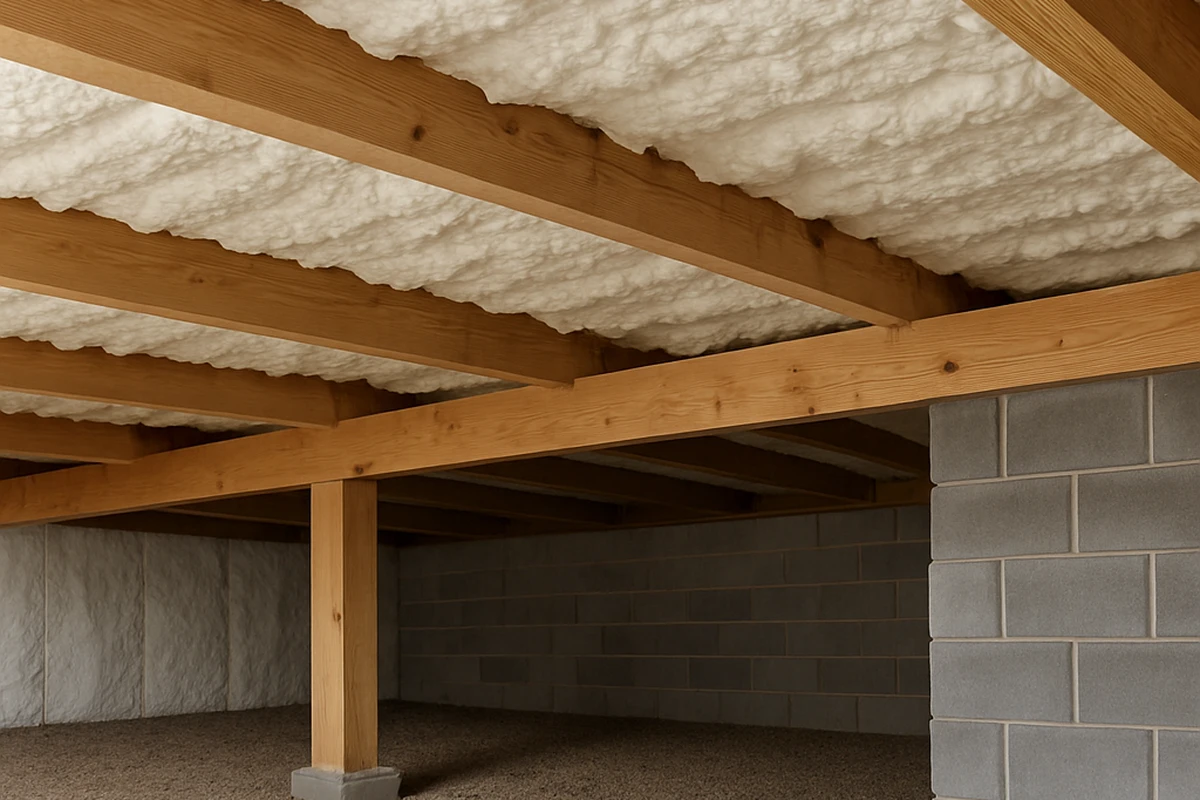
Crawl space encapsulation means sealing the entire crawl space envelope — ground floor, perimeter walls, and support piers — to create a controlled, dry, semi-conditioned space inside the building envelope. It is distinct from simply stapling fiberglass batts between floor joists (the older, now-discouraged approach) in a fundamental way: encapsulation treats the crawl space as inside the conditioned boundary of the home.
With encapsulation, humidity is controlled by the house's HVAC system (or a dedicated dehumidifier), not by outdoor air exchange through foundation vents. This eliminates the summer humidity spike that drives mold growth and wood rot in vented crawl spaces throughout Fairfax, Reston, and Prince William County.
Core Components
- 20-mil reinforced vapor barrier — Covers the ground floor, sealed to perimeter walls and support piers. Rated for 25+ years.
- Closed-cell spray foam on walls — Applied directly to crawl space walls to R-20 or higher. Also seals rim joists, the largest single air leakage path in most Northern Virginia homes.
- Sealed foundation vents — Rigid foam plugs or covers eliminate uncontrolled humid air entry.
- Dehumidifier (when needed) — Commercial-grade units (Santa Fe, AprilAire) maintain 50–55% RH year-round when HVAC alone is insufficient.
Signs Your NoVA Crawl Space Needs Treatment
- Floors feel cold in winter, regardless of thermostat setting
- Musty or earthy odors anywhere in the house, especially the first floor
- Indoor humidity above 60% even with AC running (summer)
- Visible mold on floor joists, rim joists, or subfloor — common in 1970s–1990s Fairfax, Arlington, and Reston homes
- Sagging or discolored fiberglass batt insulation between joists (moisture-saturated batts lose most of their R-value)
- Pest activity — rodents and insects prefer humid, organics-rich crawl spaces
- Wood rot on floor joists, support posts, or sill plates
- Condensation forming on ductwork or HVAC components in the crawl space
- High energy bills without an obvious cause
If you recognize three or more of these conditions, a free crawl space inspection is your logical next step. We assess moisture levels, structural condition, and the appropriate scope of work before providing a written estimate.
Your Options Compared
Not every crawl space needs the same solution. Here is how the main approaches compare for Northern Virginia conditions.
| Option | What It Includes | Thermal Value | 2026 Cost Range | Best For |
|---|---|---|---|---|
| Vapor barrier only | 6–12 mil poly liner on ground floor | R-0 (moisture control only) | $1,200–$2,500 | Minimum code compliance for vented crawl spaces; not a thermal solution |
| Fiberglass batts (floor joists) | R-19 or R-30 batts between floor joists | R-19–R-30 (degrades in humidity) | $1,500–$3,000 | Not recommended for NoVA — batts absorb moisture and lose effectiveness |
| Rigid foam board on walls (XPS/EPS) | XPS or EPS panels cut to fit crawl space walls + 20-mil ground liner | R-10–R-20 (2–4 in. XPS at R-5/in) | $1,800–$3,500 | Budget-conscious option; no air sealing benefit at seams — requires foam caulk at edges |
| Spray foam on walls only | Closed-cell spray foam on crawl space walls + 20-mil ground liner | R-20–R-30 | $3,500–$5,500 | Semi-conditioned design; solid baseline for most NoVA homes |
| Full encapsulation — standard | Spray foam on walls + 20-mil liner + sealed vents + dehumidifier | R-20–R-30 + moisture control | $5,500–$7,500 | Best long-term solution for most Northern Virginia homes |
| Full encapsulation — premium | Spray foam walls + rim joists + 20-mil liner + drainage + dehumidifier | R-20–R-38+ | $7,000–$9,500 | Wet crawl spaces, high water table, severe mold history, Woodbridge/PWC clay soil |

The Full Process
Every DMV Foam crawl space project follows the same thorough process — no shortcuts, no subcontractors. Our in-house crews handle everything from inspection to final moisture testing.
- Free inspection and assessment — We measure dimensions, map moisture sources, check for standing water, identify existing mold, and assess structural condition. We provide a written estimate before any work begins.
- Remediation (when needed) — Mold treatment with antimicrobial encapsulant, wood stabilizer for soft spots, structural repairs coordinated with licensed contractors if needed.
- 20-mil vapor barrier installation — Reinforced polyethylene liner laid on the ground floor, lapped up walls, and sealed to perimeter walls and support piers with moisture-resistant tape. All seams overlapped and sealed.
- Rim joist air sealing — Closed-cell spray foam applied directly to rim joists (the perimeter framing at the top of foundation walls). This is typically the single largest air leakage point in the house.
- Wall insulation — Closed-cell spray foam sprayed directly onto crawl space walls to the specified R-value (typically R-20 to R-30). We hold tight to local building code requirements.
- Foundation vent sealing — Rigid foam plugs or rigid covers installed in each existing foundation vent. Closed crawl space design per 2021 VRC Section R408.3.
- Dehumidifier installation (when specified) — Commercial-grade units (Santa Fe Advance or AprilAire 1820) with automatic drainage routed to exterior or to condensate pump.
- Final inspection and moisture testing — We verify RH levels and thermal performance before we leave.
Cost in Northern Virginia (2026)
Northern Virginia labor costs run 15–25% above national averages, and local soil conditions add complexity. Prince William County and Fairfax County crawl spaces frequently encounter clay-heavy soil with high moisture retention. Loudoun County homes tend to have larger footprints (more square footage = lower per-sq-ft cost, but higher total).
Typical DMV Foam Estimates
- 800 sq ft crawl space, vapor barrier + spray foam walls: $3,800–$5,200
- 1,200 sq ft, full encapsulation with dehumidifier: $6,000–$8,000
- 1,500+ sq ft, wet conditions, drainage work included: $8,500–$12,000+
Your Return on Investment
Most Fairfax County homeowners with a typical 1,200 sq ft crawl space see $350–$600 per year in energy savings after encapsulation — primarily from eliminating duct losses in unconditioned space and reducing the cooling load. Payback period: 10–15 years on energy savings alone. The hidden ROI is the avoided cost of mold remediation ($5,000–$20,000 nationally) and structural repairs that follow from years of unchecked moisture exposure.
Crawl Space Insulation in Your City
We serve the full Northern Virginia and Washington DC metro region. Find your city for locally-specific information on permits, costs, and housing stock.
Frequently Asked Questions
What is the difference between crawl space insulation and encapsulation?
Crawl space insulation typically refers to adding thermal material — usually fiberglass batts between floor joists — to reduce heat transfer. Encapsulation is more comprehensive: it seals the entire crawl space envelope (floor, walls, and sometimes ceiling) with vapor barriers and spray foam, creating a controlled, dry semi-conditioned space inside the building envelope.
In Northern Virginia's humid climate (summer crawl space RH regularly reaches 85–95% without treatment), encapsulation outperforms batt insulation significantly because it addresses both moisture and thermal problems simultaneously. The 2021 Virginia Residential Code, enforced in Fairfax County, Arlington County, Prince William County, and Loudoun County, fully supports the closed crawl space approach.
How much does crawl space encapsulation cost in Northern Virginia?
In the Northern Virginia market, expect to pay $3,500–$9,500 for a full crawl space encapsulation. Key cost drivers: crawl space square footage, height (taller spaces cost more per sq ft to access), existing moisture or mold conditions requiring remediation, and whether a dehumidifier is included.
A typical 1,000–1,200 sq ft crawl space with no standing water or mold runs $4,500–$6,500 all-in. Wet crawl spaces with drainage work run $7,000–$10,000+. All DMV Foam estimates are free, written, and provided before any work begins.
Should I use spray foam or a vapor barrier in my crawl space?
Both, in most cases — they solve different problems. A heavy-duty vapor barrier (20-mil reinforced polyethylene) on the ground floor stops moisture evaporating upward from the soil. Closed-cell spray foam on the crawl space walls provides thermal insulation and air sealing.
The most effective Northern Virginia crawl space solution combines: a 20-mil floor liner sealed to all perimeter surfaces, closed-cell spray foam on walls to R-20 or higher, sealed foundation vents, and a dehumidifier when the HVAC system alone cannot maintain target humidity.
Does my Northern Virginia home need crawl space encapsulation?
If your home was built before 1990, it almost certainly has a vented crawl space with an exposed dirt floor and either no insulation or sagging fiberglass batts. Northern Virginia's summer humidity (outdoor RH averages 72% in July–August) drives crawl space RH to 85–95% — perfect conditions for mold, wood rot, and HVAC efficiency loss.
Warning signs: musty odors on the first floor, cold floors in winter despite heating, indoor humidity above 60% despite running AC, visible mold or sagging batts beneath your subfloor, and high energy bills without a clear cause. If you see three or more of these, a free inspection is your logical next step.
How long does crawl space encapsulation last?
A properly installed system lasts 20–50 years. Closed-cell spray foam applied to clean, structurally sound surfaces has an indefinite service life and does not degrade, settle, or absorb moisture. Heavy-duty 20-mil reinforced polyethylene liners are rated for 25+ years. Dehumidifiers typically run 8–15 years before needing replacement.
The most common cause of premature failure is installing encapsulation in the presence of active water intrusion — standing water or active foundation seepage — without first addressing drainage. Our assessment process identifies these conditions before we quote.
Will crawl space encapsulation reduce my energy bills in Northern Virginia?
Yes, measurably. Northern Virginia homeowners typically see a 15–25% reduction in heating and cooling costs after crawl space encapsulation. Homes with HVAC equipment or ductwork in the crawl space see the largest gains — conditioned air moving through leaky ducts in a 90°F summer crawl space loses significant capacity before it reaches your living areas.
Most Fairfax County and Prince William County homes with a 1,200 sq ft crawl space see $350–$600 per year in energy savings, yielding a 10–15 year payback. This does not include the avoided cost of mold remediation ($5,000–$20,000) and structural repairs that follow from unchecked moisture exposure.