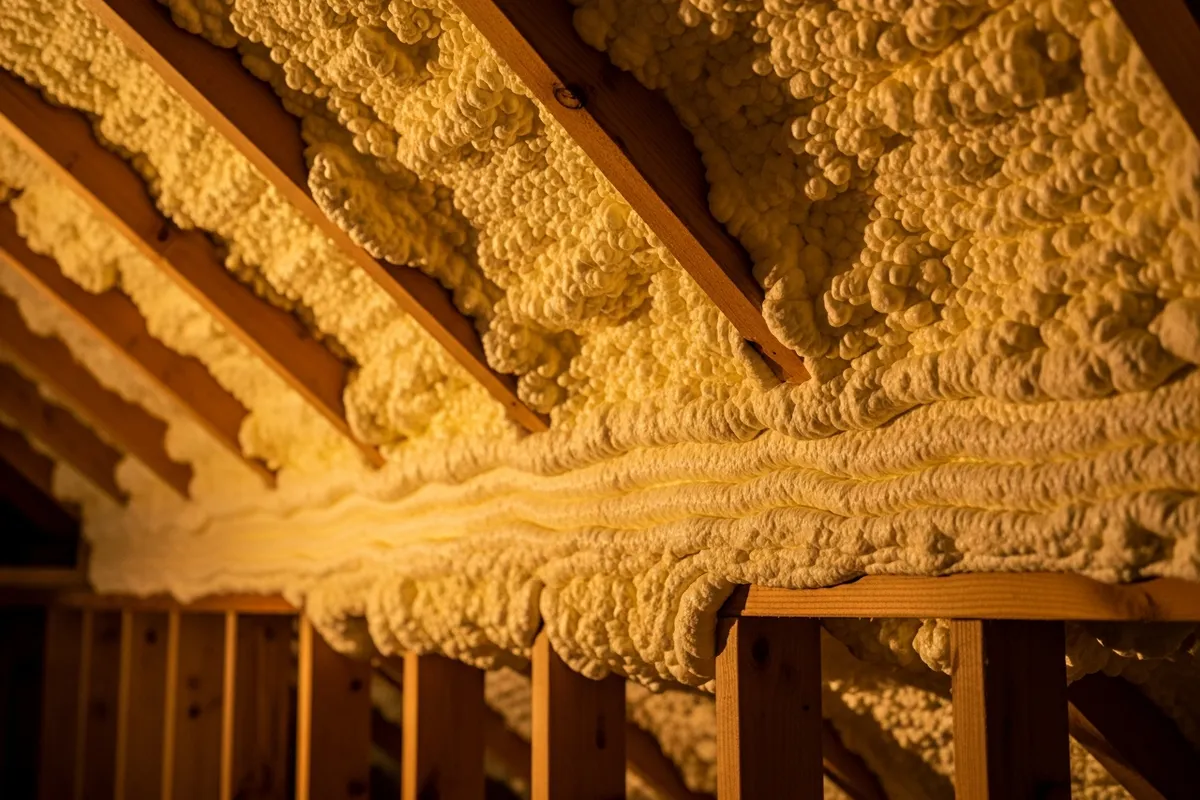
Here is a question that keeps homeowners up at night (besides wondering if they left the oven on): How thick should my spray foam insulation actually be? And while we are at it, will this stuff catch fire if my teenager leaves a candle burning in their room?
Fair questions. After 16+ years of insulating homes across Virginia, Maryland, and Washington DC, we have heard every variation of these concerns. The good news? Once you understand how spray foam insulation R-value, thickness, and fire ratings work together, choosing the right insulation becomes surprisingly straightforward.
Let us break it down in plain English, with none of the confusing technical jargon that makes most insulation guides feel like reading a physics textbook.
What Is R-Value and Why Should You Care?
R-value measures how well insulation resists heat flow. Think of it like a winter coat rating: a higher number means better protection from the cold (or heat, in summer).
Here is what makes spray foam insulation R-value special compared to other insulation types:
| Insulation Type | R-Value Per Inch | 3-Inch Application |
|---|---|---|
| Closed-Cell Spray Foam | R-6 to R-7 | R-18 to R-21 |
| Open-Cell Spray Foam | R-3.5 to R-4 | R-10.5 to R-12 |
| Fiberglass Batts | R-2.9 to R-3.8 | R-8.7 to R-11.4 |
| Cellulose (Blown-In) | R-3.2 to R-3.8 | R-9.6 to R-11.4 |
| Rigid Foam Boards | R-4 to R-6.5 | R-12 to R-19.5 |
See that? Closed-cell spray foam delivers nearly double the R-value per inch compared to fiberglass. That means you can achieve the same insulation performance in half the space, which matters a lot when you are working with limited wall cavities or trying to maximize usable attic space.
The Real Story Behind R-Value Numbers
Here is something the big-box store salespeople never mention: R-value is tested under laboratory conditions. Real-world performance depends on installation quality, air sealing, and how well the insulation handles moisture.
Fiberglass batts might promise R-13, but those fluffy pink rolls lose significant insulation value when:
- They get compressed during installation (very common)
- Gaps form around electrical boxes and pipes
- Moisture accumulates from humidity or leaks
- They sag over time, leaving bare spots at the top of wall cavities
Spray foam, on the other hand, expands to fill every nook and cranny. No gaps. No compression issues. No sagging. The R-value you pay for is the R-value you actually get, year after year. Learn more about our spray foam insulation services to see how we apply this technology in Northern Virginia and Maryland homes.
Spray Foam Insulation Thickness: How Much Do You Really Need?
This is where the rubber meets the road (or where the foam meets the studs, if we are being accurate). Spray foam insulation thickness requirements depend on three factors:
- Your climate zone (Maryland, Virginia, and DC are in Zones 4 and 5)
- What you are insulating (attic, walls, crawl space, or rim joists)
- Which type of foam you choose (open-cell vs. closed-cell)
Thickness Requirements by Application
Let us get specific. Here are the recommended spray foam insulation thickness levels for different areas of your home:
Exterior Walls (2x4 and 2x6 Stud Cavities)
- Closed-cell foam: 2 to 3 inches (R-12 to R-21)
- Open-cell foam: 3.5 inches to full cavity fill (R-12 to R-15)
- Building code minimum: R-13 to R-20 for Climate Zones 4-5
Pro tip: With 2x4 walls, you only have 3.5 inches of cavity depth. Closed-cell foam is the clear winner here because you can hit R-18+ in just 3 inches, leaving room for drywall installation.
Attics and Roof Decks
- Closed-cell foam: 4 to 6 inches (R-24 to R-42)
- Open-cell foam: 7 to 10 inches (R-25 to R-40)
- Building code minimum: R-38 to R-49 for Climate Zones 4-5
Open-cell foam works well in attics because you usually have more space, and it costs less per board foot. If you are creating a conditioned attic (spraying the underside of the roof deck), open-cell is often the most cost-effective choice. Our attic insulation services can help you determine which option works best for your home.
Crawl Spaces and Basement Walls
- Closed-cell foam: 2 inches minimum (R-12 to R-14)
- Open-cell foam: 3 to 4 inches with vapor barrier (R-10 to R-14)
- Building code minimum: R-10 continuous for foundation walls
In crawl spaces, closed-cell foam is almost always the better choice. Why? It doubles as a vapor barrier, keeping moisture out of your home. Open-cell foam absorbs moisture, which can cause problems in these naturally damp environments. For more details on crawl space applications, check out our complete guide to crawl space insulation.
Rim Joists and Band Boards
- Closed-cell foam: 2 to 3 inches (R-12 to R-21)
- Open-cell foam: Full cavity fill (R-10 to R-13)
Rim joists are the sneakiest source of energy loss in most homes. That thin strip of wood between your foundation and floor is usually completely uninsulated, creating a superhighway for cold air. A quick spray foam application here often delivers the best bang for your buck.
Quick Thickness Calculator
Want to figure out exactly how much foam you need? Use this simple formula:
Required Thickness = Target R-Value / R-Value Per Inch
Example: If you need R-20 for your walls and you are using closed-cell foam (R-6 per inch):
20 / 6 = 3.33 inches of closed-cell spray foam
Compare that to fiberglass at R-3.2 per inch:
20 / 3.2 = 6.25 inches of fiberglass
See the difference? You would need nearly twice the thickness with fiberglass to achieve the same performance. For a detailed comparison between spray foam and traditional options, read our complete guide comparing spray foam and fiberglass.
Closed-Cell Spray Foam Insulation Fire Rating: What You Need to Know
Fire safety is a legitimate concern, and it should be. Closed-cell spray foam insulation fire rating standards exist precisely because building codes take combustion seriously.
Here is the straight talk on spray foam and fire safety:
How Fire Ratings Work
Spray foam insulation is tested using ASTM E84 (Standard Test Method for Surface Burning Characteristics of Building Materials). This test measures two things:
- Flame Spread Index (FSI): How quickly fire spreads across the surface (lower is better)
- Smoke Developed Index (SDI): How much smoke the material produces when burning (lower is better)
Based on these tests, materials receive a Class rating:
| Fire Class | Flame Spread Index | Smoke Developed Index |
|---|---|---|
| Class A (Class 1) | 0 to 25 | 0 to 450 |
| Class B (Class 2) | 26 to 75 | 0 to 450 |
| Class C (Class 3) | 76 to 200 | 0 to 450 |
What Fire Rating Does Spray Foam Actually Have?
Most quality closed-cell spray foam products achieve a Class 1 (Class A) fire rating when tested. However, and this is important, spray foam must be covered with an approved thermal barrier or ignition barrier in most applications.
What counts as a thermal barrier?
- 1/2-inch drywall (most common)
- 3/4-inch plywood
- Approved intumescent coatings
- 1-1/2 inches of mineral fiber insulation
In unoccupied spaces like attics and crawl spaces, a less stringent ignition barrier (typically 1/4-inch drywall or approved coating) is often acceptable per code.
The Science of Spray Foam Fire Behavior
Spray foam is made from polyurethane, which is technically combustible. But here is what actually happens when flame contacts properly installed spray foam:
- The foam chars: The outer layer forms a protective char that resists further burning
- Self-extinguishing: Remove the flame source, and the foam stops burning
- No dripping: Unlike some plastics, spray foam does not melt and drip, which prevents fire spread
Modern spray foam formulations include fire retardants that significantly improve fire resistance. When covered with the required thermal barrier (like drywall in living spaces), the system meets or exceeds all building code requirements for fire safety.
Real-World Fire Safety Tips
Here is how we ensure maximum fire safety on every DMV Foam project:
- Never exceed manufacturer specifications: Applying foam too thick in one pass can cause overheating during curing
- Ensure proper coverage: Ignition barriers in attics, thermal barriers in living spaces
- Use code-compliant products: All our foam products carry ICC-ES evaluation reports
- Follow local amendments: Fairfax County, Montgomery County, and DC each have specific requirements
Open-Cell vs. Closed-Cell: Which Delivers Better R-Value?
This might be the most common question we hear. Here is the definitive breakdown:
Closed-Cell Spray Foam
- R-Value: R-6 to R-7 per inch (the highest of any spray foam)
- Density: 1.75 to 2.0 pounds per cubic foot
- Vapor Permeability: Very low (acts as vapor barrier at 2 inches)
- Structural Strength: Adds racking strength to walls
- Best For: Crawl spaces, basement walls, exterior walls, rim joists, areas where space is limited
Open-Cell Spray Foam
- R-Value: R-3.5 to R-4 per inch
- Density: 0.5 pounds per cubic foot
- Vapor Permeability: Higher (requires separate vapor barrier in some applications)
- Sound Dampening: Excellent acoustic properties
- Best For: Attics, interior walls (soundproofing), areas with ample cavity depth
For a more detailed comparison of these two foam types, read our open-cell vs. closed-cell spray foam article with real-world use cases.
Cost Comparison
Closed-cell foam costs more per board foot ($1.00 to $2.00) than open-cell ($0.50 to $1.00). But because you need less thickness to achieve the same R-value, the total project cost often ends up similar. The real savings come from better energy efficiency and moisture control over the lifetime of your home.
Building Code Requirements for Maryland and Virginia
Both Maryland and Virginia follow the International Energy Conservation Code (IECC) with local amendments. Here is what you need to know:
Climate Zone 4 (Most of Virginia, Southern Maryland)
- Walls: R-13 cavity + R-5 continuous OR R-20 cavity
- Ceiling/Attic: R-49
- Floor over unconditioned space: R-19
- Basement walls: R-10 continuous OR R-13 cavity
- Crawl space walls: R-10 continuous
Climate Zone 5 (Northern Virginia Mountains, Western Maryland)
- Walls: R-13 cavity + R-5 continuous OR R-20 cavity
- Ceiling/Attic: R-49
- Floor over unconditioned space: R-30
- Basement walls: R-15 continuous OR R-19 cavity
- Crawl space walls: R-15 continuous
With closed-cell spray foam, meeting these requirements is remarkably easy:
- 2 inches of closed-cell = R-12 to R-14 (meets crawl space requirements)
- 3 inches of closed-cell = R-18 to R-21 (exceeds most wall requirements)
- 5 inches of closed-cell = R-30 to R-35 (meets floor requirements)
Homeowners in Maryland can learn more about regional costs and considerations in our spray foam insulation guide for Baltimore and Maryland.
Common Mistakes to Avoid
After thousands of installations, we have seen every mistake in the book. Here is how to avoid the most common ones:
Mistake 1: Choosing by R-Value Alone
R-value matters, but it is not everything. Air sealing provides 40% of your insulation value. Spray foam delivers both insulation AND air sealing in one application, while fiberglass requires separate air sealing measures that often get skipped.
Mistake 2: Skipping the Vapor Barrier Assessment
In crawl spaces and basements, moisture control is just as important as thermal performance. Closed-cell foam at 2 inches thick acts as its own vapor barrier (Class II vapor retarder), while open-cell foam requires a separate vapor barrier in below-grade applications. Our crawl space encapsulation service addresses both insulation and moisture control together.
Mistake 3: Ignoring Fire Code Requirements
Some DIY enthusiasts and even inexperienced contractors skip the required thermal barriers. This is a code violation that can void your insurance and create real safety hazards. Always ensure proper covering per local building codes.
Mistake 4: Going Too Thick in One Pass
Spray foam generates heat as it cures. Applying more than 2 inches of closed-cell foam in a single pass can cause scorching, shrinkage, and off-gassing. Professional installers apply multiple thin lifts, allowing each layer to cure before adding the next. Learn more about proper application techniques in our spray foam insulation safety guide.
Ready to Learn the Right R-Value for Your Home?
Get a free home evaluation and discover how modern spray foam solutions can solve your comfort and energy problems.
Schedule Your Free Consultation