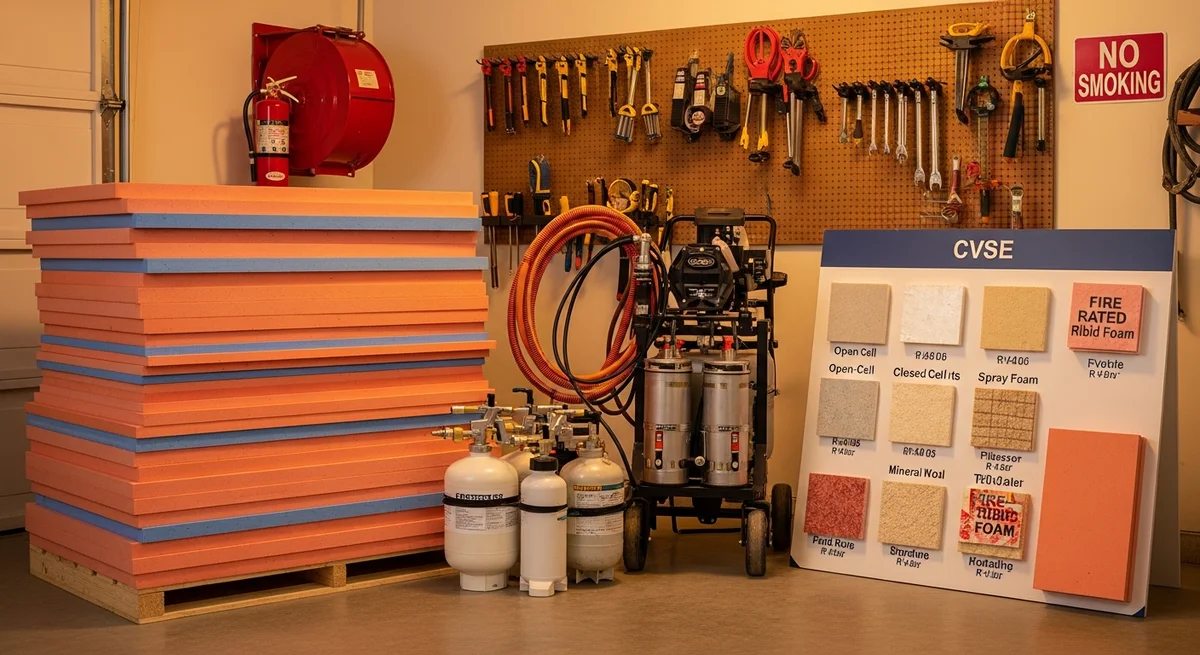
Fire safety and insulation seem like they should not mix. Foam is flammable, right? So how can it be installed in homes?
This is one of the most common concerns homeowners have when considering foam insulation. The good news is that modern fire rated rigid foam insulation and closed cell spray foam insulation fire rating standards exist specifically to address this.
Let us clear up the confusion and help you understand what fire ratings mean, where different foam types work best, and what questions to ask before your project.
What "Fire-Rated" Actually Means
When people ask about fire-rated foam insulation, they usually want to know: will this burn and create a safety hazard?
The answer involves understanding a few key concepts:
Flame Spread Rating
This measures how quickly flames travel across a material's surface. Lower numbers are better. Materials are grouped into classes:
- Class A (Class I): Flame spread of 0-25. Best rating.
- Class B (Class II): Flame spread of 26-75. Good rating.
- Class C (Class III): Flame spread of 76-200. Acceptable for many uses.
Smoke Development Rating
This measures how much smoke a material produces when burning. Again, lower is better. Most building codes limit smoke development to 450 or less for interior applications.
Thermal Barrier Requirements
This is where it gets practical. Building codes require foam insulation to be covered with a "thermal barrier" in most living spaces. The standard is a 15-minute barrier, which 1/2-inch drywall provides.
The barrier slows heat transfer to the foam during a fire, giving occupants time to escape and firefighters time to respond.
Fire-Rated Rigid Foam Insulation: Where It Is Commonly Used
Fire rated rigid foam insulation boards come in several types, each with different properties and fire ratings:
Common Rigid Foam Types
| Foam Type | R-Value Per Inch | Typical Fire Rating |
|---|---|---|
| Polyisocyanurate (Polyiso) | R-5.6 to R-6.5 | Class A with foil facing |
| Extruded Polystyrene (XPS) | R-5 | Class A with fire retardants |
| Expanded Polystyrene (EPS) | R-3.8 to R-4.4 | Class B or C typically |
Where Homeowners Like Rigid Foam
- Basement walls: Clean, predictable installation with consistent thickness
- Garage walls and ceilings: Easy to cut and fit around obstacles
- Exterior sheathing: Adds insulation and reduces thermal bridging
- Flat surfaces: Works well where spray foam equipment access is difficult
Rigid foam boards appeal to homeowners who want clean lines and predictable coverage. The boards come in standard thicknesses, making it easy to calculate R-value.
Closed-Cell Spray Foam Fire Rating: What Homeowners Should Know
The closed cell spray foam insulation fire rating question comes up constantly. Here is what you need to understand:
Spray Foam Is Not Fireproof, But It Is Fire-Resistant
Modern closed-cell spray foams contain fire retardants and achieve Class I flame spread ratings when tested. They do not sustain combustion on their own. If you remove the heat source, the foam stops burning.
However, spray foam does require a thermal barrier in most applications. This is not because it is dangerous. It is because building codes take a conservative approach to fire safety.
Where Spray Foam Can Be Left Exposed
Building codes allow spray foam without a thermal barrier in certain situations:
- Attics: If access is only for service (not storage or living space)
- Crawl spaces: With limited access and no habitation
- Unoccupied areas: Mechanical rooms, utility spaces
Some spray foam products are formulated to meet "ignition barrier" requirements, which is a less stringent standard than a thermal barrier. These can be used in more areas without covering.
Reassurance for Homeowners
Millions of homes have spray foam insulation. When properly installed by trained professionals using quality materials, it meets all safety requirements. The key is working with contractors who follow building codes and manufacturer specifications.
For detailed information on spray foam performance characteristics, check our complete guide to R-value, thickness, and fire ratings.
Which One Should You Pick?
The choice between rigid foam and spray foam often comes down to your specific situation. Here are some guidelines:
If Your Goal Is DIY-Friendly Installation
Pick rigid foam boards. They are easier to handle, cut with standard tools, and install without specialized equipment. You can insulate a basement wall yourself over a weekend.
If Your Goal Is Maximum Air Sealing
Pick spray foam. It expands to fill gaps and creates an air barrier that rigid boards cannot match. For drafty homes or complex geometries, spray foam delivers better results.
If Your Goal Is Insulating Irregular Spaces
Pick spray foam. Rim joists, cathedral ceilings, and odd-shaped cavities are difficult to insulate properly with rigid boards. Spray foam conforms to any shape.
If Your Goal Is Visible Finished Walls
Either works since both require covering with drywall in living spaces. Choose based on other factors like air sealing needs and budget.
If Your Goal Is Budget-Conscious Insulation
Rigid foam boards typically cost less, especially if you install them yourself. Spray foam costs more but often delivers better long-term energy savings.
Questions to Ask Before You Start
Whether you choose rigid foam or spray foam, ask these questions before beginning your project:
- Does my application require a thermal barrier? (Usually yes in living spaces)
- What fire rating does the product achieve?
- Are there local code requirements I need to meet?
- Will the installer obtain necessary permits?
- What is the manufacturer warranty on the insulation?
- How will moisture be managed in this application?
A reputable contractor will answer these questions clearly and pull any required permits. If someone tells you permits are not needed or codes do not apply, consider that a red flag.
Frequently Asked Questions
Is spray foam insulation fire-rated?
Spray foam insulation is rated for flame spread and smoke development, but it is not fireproof. Most closed-cell spray foams achieve Class I or Class A fire ratings when properly covered with a thermal barrier like drywall. The foam does not sustain combustion on its own.
Does spray foam need to be covered with drywall?
In most living spaces, yes. Building codes require spray foam to be covered with a 15-minute thermal barrier (typically 1/2-inch drywall) in areas where people spend time. Exceptions exist for attics and crawl spaces with limited access.
What is the fire rating of rigid foam insulation?
Fire-rated rigid foam boards typically achieve Class A flame spread ratings with added fire retardants. Some products are designed specifically for fire-rated assemblies and can maintain ratings for 1 to 2 hours when used correctly.
Which is better for garage insulation: rigid foam or spray foam?
Both work well for garage insulation when properly installed. Rigid foam boards are easier to install yourself and provide clean lines. Spray foam offers better air sealing. Either option needs covering with a thermal barrier in attached garages.
Can I use foam insulation in my basement?
Yes. Both rigid foam and spray foam are excellent for basement insulation. Closed-cell spray foam provides moisture resistance plus insulation. Rigid foam boards work well on flat foundation walls. Both need covering with drywall in finished basement spaces.
Ready to Discuss Your Project?
Understanding fire ratings is important, but the best way to know what works for your home is to talk with an experienced professional. We can assess your situation, explain code requirements, and recommend the right approach.