If you have been researching insulation options, you have probably seen a lot of talk about closed cell spray foam insulation R-value. Numbers get thrown around like confetti at a parade. R-19 here. R-60 there. But what does any of it actually mean for your house?
Here is the short version: R-value measures how well insulation resists heat flow. Higher numbers mean better insulation. But the full story is more interesting, and knowing it can save you money while keeping your home comfortable year-round.
DMV Foam serves Maryland and the greater Washington DC area, and we have installed foam in hundreds of homes with different needs. This guide breaks down what you actually need to know about R-value, thickness, and whether those big numbers matter for your specific situation.
What "Closed Cell Spray Foam" Is (In Homeowner Language)
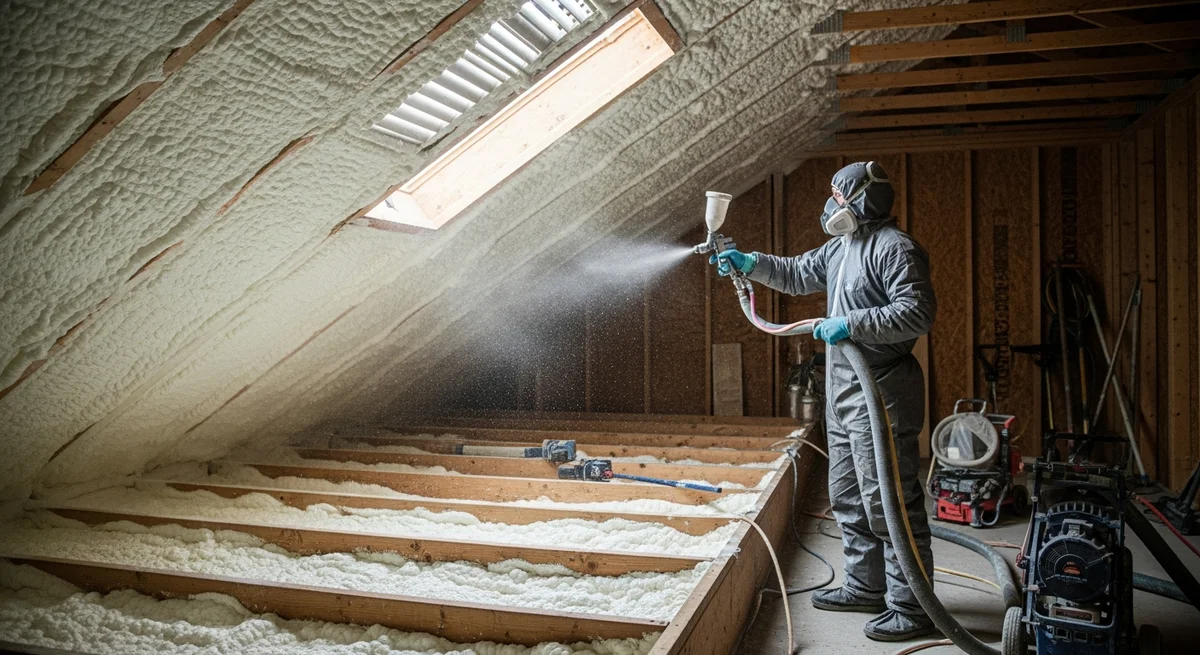
Closed cell spray foam is a dense, rigid insulation that expands when applied and hardens into a solid barrier. Unlike fiberglass batts that just sit in cavities, spray foam expands to fill every gap, crack, and weird angle in your walls, attic, or crawl space.
The "closed cell" part refers to the foam structure. Each tiny bubble in the foam is completely sealed off from its neighbors. This creates two important benefits:
- Higher R-value per inch than almost any other insulation type
- Moisture resistance because water cannot pass through those sealed cells
- Structural strength that can add rigidity to walls and roofs
This makes closed cell foam the go-to choice when space is tight (like in 2x4 wall cavities) or when moisture control matters (basements, crawl spaces, rim joists). For a deeper look at when to use closed cell versus open cell, check out our open cell vs closed cell comparison guide.
Closed Cell Spray Foam Insulation R-Value (What It Actually Means)
R-value stands for "resistance value." It measures how well a material resists heat moving through it. The higher the number, the harder it is for heat to escape in winter or invade in summer.
Closed cell spray foam insulation R-value typically ranges from R-6 to R-7 per inch. That is nearly double the R-value of fiberglass batts (around R-3.2 per inch) and significantly higher than open cell spray foam (R-3.7 per inch).
| Insulation Type | R-Value Per Inch | Notes |
|---|---|---|
| Closed Cell Spray Foam | R-6 to R-7 | Highest per-inch value; adds moisture barrier |
| Open Cell Spray Foam | R-3.5 to R-3.8 | Good for sound; requires vapor retarder in some climates |
| Fiberglass Batts | R-3.0 to R-3.7 | Affordable; gaps reduce real-world performance |
| Blown Cellulose | R-3.2 to R-3.8 | Eco-friendly; settles over time |
But here is the thing most people miss: R-value only measures thermal resistance. It does not account for air leakage, which is often a bigger energy thief than poor insulation. A wall with R-13 fiberglass full of gaps around outlets and pipes can lose more heat than an R-10 spray foam wall that is completely air-sealed.
R-Factor Spray Foam Insulation vs Air Sealing (Why People Feel a Difference Fast)
When homeowners get spray foam installed, they usually notice a comfort difference within the first day. Not because the r factor spray foam insulation is magically high, but because the foam seals air leaks that traditional insulation ignores.
Air leakage causes problems that R-value alone cannot fix:
- Drafts near windows, doors, and exterior walls
- Hot upstairs rooms where summer heat stacks up
- Cold floors in winter, especially over crawl spaces or garages
- Humidity problems from outdoor air sneaking inside
- Uneven temperatures between rooms
Spray foam stops all of this because it expands into every crack and crevice during application. You get insulation AND air sealing in one step. That combination is why foam often outperforms insulation with higher R-values on paper.
For a practical look at how this translates to energy savings, our energy savings guide for DC area homes breaks down real numbers from actual projects.
How Thick Is Spray Foam Insulation (Simple Rule of Thumb)
Understanding how thick is spray foam insulation comes down to simple math: take your target R-value and divide by the foam R-value per inch.
For closed cell foam at R-6.5 per inch:
- R-13 wall target: About 2 inches of closed cell foam
- R-19 floor target: About 3 inches of closed cell foam
- R-38 attic target: About 6 inches of closed cell foam
- R-49 attic target: About 7.5 inches of closed cell foam
Different areas of your home may need different thicknesses. A rim joist might only need 2 to 3 inches for adequate protection, while an attic roofline might need 5 to 7 inches depending on your energy goals and local code requirements.
Installers apply foam in "lifts" of about 2 inches at a time. This allows each layer to cure properly and prevents issues like charring or off-gassing. A 6-inch application would typically mean three separate passes, which is why larger projects take longer. Learn more about our spray foam insulation services and what to expect during installation.
R19 Spray Foam Insulation Thickness (When People Use R-19)
R19 spray foam insulation thickness is a common target for floors over unconditioned spaces and certain wall assemblies. With closed cell foam, you would need approximately 3 inches to reach R-19.
Where R-19 typically makes sense:
- Floors above crawl spaces: Stops cold floors in winter and moisture intrusion
- Floors above garages: Prevents garage fumes and temperature swings from affecting living spaces
- Some wall assemblies: Where 2x6 construction allows for thicker insulation
- Basement walls: Where code requires R-19 in the cavity
Here is a practical consideration: you do not always need to hit R-19 with foam alone. Some contractors install 2 inches of closed cell foam for air sealing and moisture control, then fill the remaining cavity depth with less expensive insulation. This hybrid approach can save money while still delivering excellent performance.
Our crawl space insulation services often use this approach to maximize value for homeowners.
R60 Spray Foam Insulation (Who Needs It and Why It Is Usually Attic-Focused)
R60 spray foam insulation is not something most Maryland homes require, but it shows up in discussions for good reason. Higher R-values in attics pay off because that is where you lose the most energy.
Heat rises, and in winter, your heated indoor air pushes up against the ceiling. In summer, the sun beats down on your roof, which can hit 150 degrees on a July afternoon. Either way, the attic is working overtime to transfer heat in directions you do not want.
Maryland building code typically requires R-49 for attic insulation. R-60 exceeds that requirement and makes sense for:
- Homeowners prioritizing maximum efficiency: Lower energy bills over the long term
- Homes with HVAC equipment in the attic: Better protection means the system works less
- Passive house or near-passive house goals: Extreme insulation levels for minimal energy use
Reaching R-60 with closed cell foam alone would require about 9 to 10 inches, which gets expensive. Most projects targeting R-60 use a combination approach: 3 to 4 inches of closed cell spray foam for air sealing and moisture control, topped with blown cellulose or fiberglass to reach the final R-value. This cuts costs while still delivering elite performance.
For more on attic-specific strategies, our attic insulation page covers what works best in Maryland homes.
Spray On Closed Cell Foam Insulation: Install Quality Checklist
Even the best spray on closed cell foam insulation will underperform if the installation is sloppy. R-value numbers assume perfect coverage, but real-world performance depends on the crew doing the work.
What a quality installation looks like:
- Consistent coverage: No thin spots, gaps, or missed areas along edges and corners
- Proper thickness: Foam applied in appropriate lifts (usually 2 inches per pass) to prevent overheating during curing
- Good adhesion: Foam sticks firmly to surfaces without peeling or delamination
- Uniform color: Even cream or off-white color throughout (charring or dark spots indicate problems)
- Clean transitions: Smooth application around wires, pipes, and other penetrations
Before installation day:
- Surface prep: Work area should be clean, dry, and free of dust or debris
- Moisture check: Any active leaks or water issues need to be fixed first
- Ventilation plan: Installer should explain how they will handle off-gassing during curing
- Re-entry time: You should know when it is safe to return to the work area (typically 2 to 24 hours)
A reputable installer will take before and after photos, let you inspect the work, and answer questions about curing times and what to expect. For a deeper dive into safety considerations, check our spray foam safety guide for families and pets.
Mistakes Homeowners Should Avoid
We see a few common missteps when homeowners tackle spray foam projects without a clear plan:
Going Thick Everywhere Without a Strategy
More is not always better. Spraying 6 inches in a wall that only needs 3 wastes money without proportional benefits. A good contractor will recommend thickness based on your actual needs, not just maximum R-value everywhere.
Ignoring Ventilation
Some spaces need to breathe. Sealing an attic roof deck changes how moisture moves through your home. Without proper planning, you can trap humidity where it causes problems. Make sure your contractor understands your home's ventilation strategy.
Skipping Air Leakage Points
The biggest energy losses often happen at small penetrations: electrical boxes, plumbing pipes, recessed lights, HVAC ducts. If the foam does not seal these, you are missing the main benefit of choosing spray foam over other insulation types.
Not Addressing Moisture Issues First
Spray foam over a leaky roof or wet crawl space just traps the problem. Any water intrusion issues need to be fixed before insulation goes in. A quality contractor will inspect for these problems before starting work.
Choosing the Cheapest Bid Without Questions
Spray foam quality varies. Low bids sometimes mean thin applications, skipped areas, or inexperienced crews. Ask about foam brands, application thickness, and crew training before signing a contract.
Frequently Asked Questions
Is closed cell spray foam insulation R-value higher than other insulation types?
Yes. Closed cell foam delivers R-6 to R-7 per inch, nearly double fiberglass and significantly higher than open cell foam. This makes it ideal where space is limited or maximum insulation is needed in minimal thickness.
How thick is spray foam insulation in attics vs walls?
Walls typically get 2 to 3 inches of closed cell foam to fill stud cavities. Attics often receive 4 to 7 inches to reach higher R-values like R-38 or R-49. The exact depth depends on your goals and local code requirements.
What does R-19 spray foam insulation thickness mean for a real project?
R-19 is common for floors over unconditioned spaces. With closed cell foam at roughly R-6.5 per inch, you need about 3 inches to reach R-19. Installers apply it in lifts to ensure proper curing.
Is R-60 spray foam insulation always necessary in Maryland homes?
No. Maryland code requires R-49 for attics. R-60 exceeds requirements and is typically chosen by homeowners wanting maximum efficiency. Many projects combine foam with blown insulation to reach R-60 at lower cost.
How do I know if spray on closed cell foam insulation was installed correctly?
Look for consistent coverage without gaps, voids, or thin spots. The foam should have uniform texture and color without charring. Quality installers provide before/after photos and let you inspect before they leave.
Get the Right R-Value for Your Home
Not sure what thickness or R-value makes sense for your specific project? Our team inspects first, then recommends based on your home's actual needs.
Call us at (571) 977-8247
Request an Evaluation